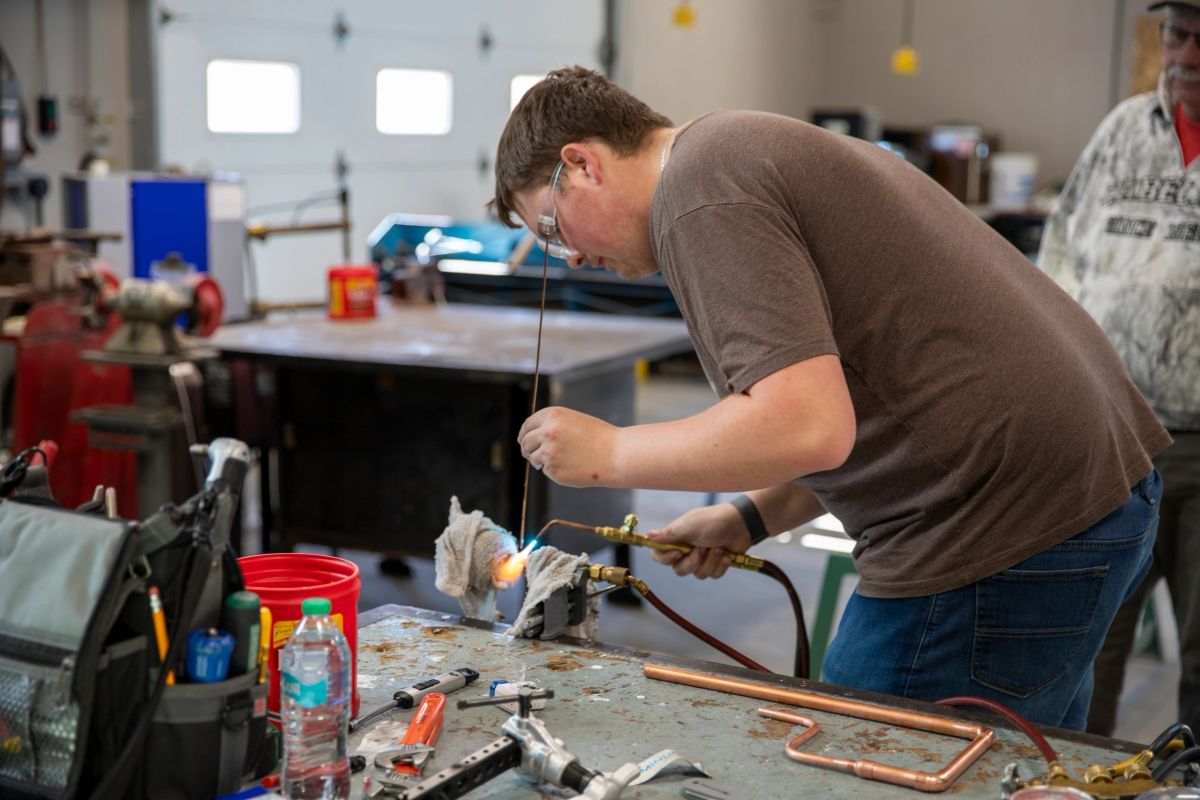
Ask a South Dakota employer why a new hire did not work out and you will almost never hear 'they couldn't do the job.' Here is what they actually hire for — and how students build it before graduation.
There is a conversation that happens constantly in South Dakota — in shop offices, hospital break rooms, restaurant kitchens, and manufacturing HR departments — and it goes almost the same way every time. An employer is asked what they need from schools. They say they need more skilled people. Then, if you keep them talking for another two minutes, they revise it: what they really need is people who show up on time, communicate, take feedback, and care about the work. The technical part, most of them say, they can teach.
That revision is the whole story of modern hiring in the skilled trades and technical fields. Technical competence gets a candidate into the conversation. Everything else decides whether they stay, advance, and get invested in. This article covers what 'everything else' actually consists of, why it is harder to teach than it sounds, and how career and technical education programs build it deliberately rather than hoping it happens.
Why the phrase 'soft skills' undersells the problem
The term 'soft skills' implies optional polish — nice if you have it. That framing is wrong and it hurts students. These are not softeners around a technical core; they are the operational requirements of the job. A technician who cannot explain a diagnosis to a customer costs the shop money. A welder who cannot take correction produces the same defect twice. An employee who is unreliable makes the entire crew's schedule unreliable.
SkillsUSA addresses this with an explicit structure. The SkillsUSA Framework organizes what employers want into three integrated components: personal skills, workplace skills, and technical skills grounded in academics. Treating them as one integrated system — rather than technical training with a leadership club attached — is precisely the point.
Personal skills: the ones that decide whether you keep the job
Integrity
In technical fields, integrity has a literal safety dimension. A student who reports the mistake they made on a torque spec, admits they skipped a step, or flags a defect they caused is protecting people. Employers know this. They will forgive an error disclosed immediately and never fully trust someone who hid one. The habit is built in the classroom: teachers who make it safe and expected to report your own errors are doing genuine workforce preparation.
Work ethic
Work ethic is measured concretely: attendance, punctuality, staying with a hard task, and finishing without supervision. Every South Dakota employer surveyed on this topic ranks attendance near the top, and every CTE instructor has watched a technically gifted student lose an opportunity to a less-skilled classmate who never missed a day. The uncomfortable truth for students is that this is the easiest of all these skills to demonstrate and the most commonly failed.
Professionalism
Professionalism covers appearance appropriate to the setting, language control, phone discipline, and the ability to represent an employer in front of a customer. It is not about being formal — a diesel shop is not a law firm — it is about signaling that you understand where you are and who is watching. Students often learn this fastest through customer-facing work or through contest interviews, where the standard is unmistakable.
Responsibility and self-motivation
The trait supervisors describe most often as the difference-maker is what they call 'not needing to be told.' The employee who sees the shop is out of consumables and orders them, who cleans the bay without being asked, who reads the manual on a new machine over lunch — that person moves up quickly, because supervisors are chronically short on attention and reward anyone who reduces their load.
Workplace skills: the ones that decide how far you go
Communication
Technical communication is a specific, learnable skill: explaining a problem to someone who does not share your expertise, writing a service note another technician can act on, asking a question precisely enough to get a useful answer, and listening to instructions without filling in assumptions. In most technical workplaces, the highest-paid people are the ones who can translate between the shop floor and the customer or the front office.
Teamwork
Nearly all technical work is interdependent. The electrician's schedule depends on the framer. The nurse's shift depends on the handoff. Teamwork in practice means communicating status without being asked, absorbing an unfair share of work occasionally without keeping score, and resolving disagreement without escalating it. Students practice this in team contests and chapter projects, which is why those experiences transfer better than group projects graded on a shared score.
Adaptability and problem-solving
Plans fail daily in technical work. Parts arrive wrong, equipment fails, a customer changes scope, weather stops the job. What employers watch for is the response: does this person freeze, complain, and wait for direction, or assess and propose an option? The most valuable version of this skill is bringing your supervisor a problem with a suggested solution attached rather than a problem alone.
Planning, organizing, and time management
This shows up as the ability to sequence a job, estimate how long steps take, stage materials before starting, and finish within a window. It is directly trainable through contest preparation, where a fixed time limit makes poor planning immediately visible. It is also the skill that most cleanly predicts who eventually becomes a foreman.
Multicultural sensitivity and customer service
South Dakota's workforce and customer base are more diverse than the state's reputation suggests, and technical work is increasingly customer-facing. Treating people with respect regardless of background is both a decency issue and a business one — service technicians who make customers comfortable generate repeat work, and crews that function across differences simply produce more.
Employers can teach a torque spec in an afternoon. They cannot teach reliability in a quarter.
Technical skills grounded in academics
The third component of the framework matters because technical skill without academic grounding hits a ceiling fast. The math of layout and material takeoff, the reading comprehension required by codes and service manuals, the writing needed for documentation, and the scientific reasoning behind diagnostics all determine how complex a job a person can take on.
This is worth saying plainly to students who dislike academic classes: the reason to learn geometry is not the test. It is that a carpenter who cannot calculate a rafter length, or a technician who cannot interpret a wiring diagram, is capped at the simplest work in their trade regardless of how good their hands are.
How these skills get built (they do not develop by accident)
Employability skills are habits, and habits form through repetition with feedback. A CTE program that wants to produce them deliberately can build them into ordinary operations.
- Run the classroom like a workplace. Clock-in expectations, shop-appropriate dress, and consequences for lateness teach more than a lecture on responsibility.
- Grade process, not just product. Award points for cleanup, tool return, safety compliance, and documentation the way an employer would.
- Require students to explain their work out loud. Verbal defense of a technical decision builds communication faster than any writing assignment.
- Use real customers. Community service projects and school work orders introduce accountability that a practice exercise cannot.
- Bring in industry professionals to observe, judge, and interview. External standards land differently than a teacher's.
- Give leadership roles with real duties, and let students fail small before they fail expensively.
What SkillsUSA competition contributes specifically
Competition happens to be an unusually efficient delivery mechanism for these skills, because it packages them into a single graded event.
- Résumé and interview components force students to articulate their own value to an adult who is scoring them.
- Official dress requirements make professional presentation a rule rather than a suggestion.
- Time-limited tasks train planning and composure under observation.
- Score sheets deliver specific, unsentimental feedback — the closest thing to a performance review most students will experience before employment.
- Team contests create genuine interdependence where a teammate's failure is your failure too.
- Industry judges provide external validation that a classroom grade cannot.
This is why employers who judge SkillsUSA contests so frequently become sponsors and then employers of the students they judged. They are not being charitable. They have watched a student handle instruction, pressure, setback, and cleanup — which is far more information than any interview provides.
For students: what to do with this
If you are a student reading this, the practical takeaway is that you can distinguish yourself faster through behavior than through talent. Consider what that means concretely over one semester:
- Perfect attendance in your CTE course, and arriving before the bell rather than with it.
- Ask one substantive question every class. It builds the habit of asking precisely.
- Volunteer for the least popular task at least once a week.
- Take one piece of critical feedback without defending yourself, then visibly apply it.
- Clean up beyond your own station.
- Write and maintain a real résumé, updated every time you earn something.
Do that for four months and your instructor's recommendation changes character entirely — from 'good student' to 'I would hire this person myself.' That sentence, from someone employers trust, is worth more than any line on a transcript.
For employers: how to get the workforce you want
Employers who complain about workforce readiness while staying disconnected from schools are describing a problem they can partly solve. The highest-leverage actions are unglamorous: judge a contest, host a tour, sponsor a chapter, sit on a program advisory committee, offer a summer position to a sophomore, or send a technician to speak for forty minutes. Every one of those creates direct contact between your standards and a student's development — years before you would otherwise meet them.
In a state where nearly every technical employer is competing for the same graduates, the ones who show up in classrooms and at the state conference are simply first in line. That is not a favor to the schools. It is a recruiting strategy with an unusually long runway.
If you want to plug into that pipeline, SkillsUSA South Dakota can connect you with judging, sponsorship, and chapter partnership opportunities across the state.
Get involved with SkillsUSA South Dakota
Students, advisors, and industry partners across South Dakota build the state's skilled workforce together. Start a chapter, sponsor a contest, or bring your students to the state conference in Watertown.